
The Neighbour Nobody Mentions: Reading Power Station
The 1938 power station sits beside the district on the southern edge. What the record says about its presence, its stop generating, and its unsettled second life.
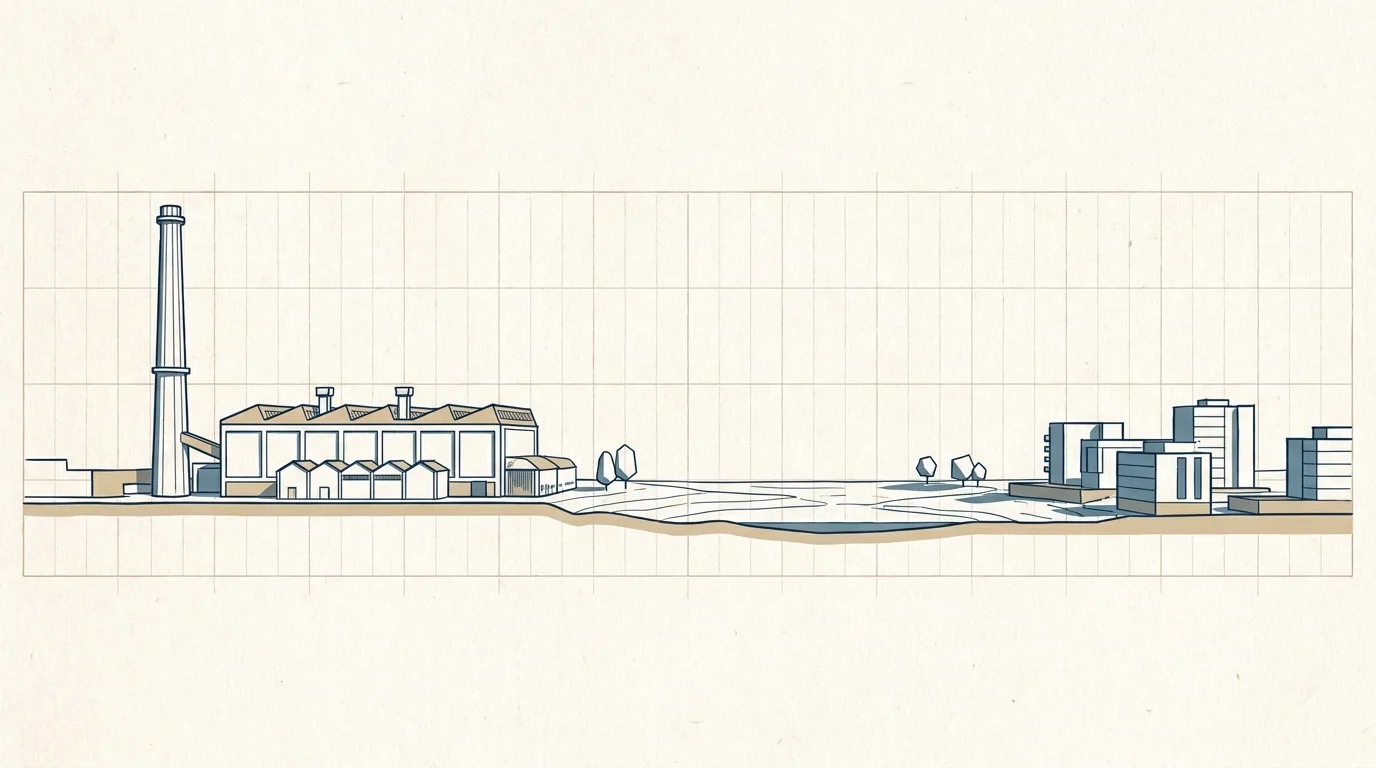
Two 1938 Openings on One Coast
Dov Hoz airfield opened on 3 September 1938. The same year, Pinchas Rotenberg's Reading Power Station (תחנת כוח רדינג, Reading) opened on the southern edge of the same coastal strip. For decades, chimneys and fuel tanks framed every aerial of the runway that would become Sde Dov District.
Plan TA/4444 covers about 1,300 dunams of former airfield, in force from August 2020. Reading sits beside that line, not inside the residential lot grid. The hotels-marina-reading post owns the marina tender, the tank lighting, and the tourism program. This post takes the neighbour angle: what Reading is, what changed in 2024, and what the file does not yet settle.
An August 2026 historical feature added that Reading was also a secret Haganah (הגנה, pre-state Jewish defence force) weapons factory. That is cultural context on the same site, not a planning permit.
Airfield 1938: timeline. Reading founding and Haganah history: district records, 17 Aug 2026; history-of-sde-dov-airport post.
What the Record Shows About the Station Today
On 30 January 2024, district records reported that Reading would stop generating electricity and that the site would turn toward "green and innovative" uses. That announcement is the central fact about Reading's relationship to the new district: active power generation ending, not necessarily structures disappearing overnight.
Generation ending is not the same as demolition. The corpus does not give a decommissioning schedule for every chimney or tank. It does not publish emissions data or a final environmental closure certificate in the compiled research. Where the future program is described in headlines, it is qualitative: green, innovative, culture, leisure.
Buyers who walk Reading Park today, described in an August 2023 magazine feature as a place for a picnic, a run, a seat by the lighthouse, or a sunset, are already inside a transition the 2024 announcement started. The park sits outside TA/4444's 365 dunams of internal parks but inside the walk from Eshkol toward the sea.
Generation cease: district records, 30 Jan 2024. Reading Park: 30 Aug 2023.
South of the Plan Line, South of Eshkol
Mitcham Eshkol (מתחם אשכול, the southern complex) is the district's gateway toward Reading. Propes station on the Green Line is planned at the southern entry, near the Reading edge and the connection toward central Tel Aviv. The parks-and-beach post notes construction began in August 2026 on a bridge linking Eshkol to Yarkon Park, another connector toward existing waterfront south of the field.
Reading is therefore the landscape Eshkol faces on its southern side: tanks, brick structures, park grass, and marina planning. It is not a migrash inside lots 101 through 111. A buyer on lot 110 (ZOHI) or lot 103 (UTOPIA) should read southern views against that edge, not only against Coastal Park to the west.
The district catalog lists Atarim, the Tel Aviv municipal development company, in connection with nightly illumination of Reading's giant steel fuel tanks, reported on 2 February 2025 as a new urban icon. Illumination is a present fact. Final land use for the tanks is still described in future tense in May 2026 coverage about a culture and leisure hub.
Marina, Tanks, and Unsettled Programs
On 2 April 2024, district records show approval of a plan for Ma'aganat Reading (מעגנת רדינג, Reading marina): a leisure and water-sports marina with about 300 moorings. The mooring count is sourced. Opening dates are not in the compiled record.
A May 2026 headline described giant steel fuel tanks south of Sde Dov becoming a culture and leisure hub. That sits in the same geography as the marina approval and Reading Park. The corpus connects the narrative threads. It does not name every tenant, operator, or completion year.
Do not invent decommissioning dates for individual structures or emissions tables for the station's past operations. The file supports: generation stopping per the 2024 announcement, marina scale per the 2024 approval, tank lighting per the 2025 report, and culture/leisure language per 2026 coverage. Anything finer requires a lot-level or operator-level source not present here.
What Reading Is Not in the PFAS File
PFAS compounds from firefighting foam were disclosed in the old airport's soil and groundwater in February 2026. Runway foam and airport operations are the contamination story tied to TA/4444 lots. The compiled research does not extend that disclosure into emissions statistics for Reading's decades of power generation.
Environmental Protection Ministry demands to halt infrastructure works in Sde Dov in July 2026 concern the district build-out, not a separate Reading cleanup schedule in the news archive summarized here. ASHIRA on lot 101 tested clean of PFAS in later coverage. That is a lot-level finding on the airfield, not a statement about Reading's chimney stack.
Treat Reading as a neighbouring land-use transition with its own planning headlines. Treat PFAS as an airfield-soil file. Conflating them without a sourced link would overstate what the repository contains.
View Corridors and Buyer Expectations
A lower floor at the southern edge of Eshkol may look toward park and tanks-turned-cultural-hub instead of an active power station, a shift the 2024 generation announcement began. The corpus does not guarantee every upper floor will keep that view after future construction on Reading's site.
Night lighting on the tanks, approved as an urban icon project, changes the evening character of the southern horizon. That is amenity or nuisance depending on taste. The file records the lighting project, not resident opinion surveys.
If a sales brochure mentions "Reading" only as heritage charm, ask what is permitted on the site today versus what is still a headline. Green and innovative uses are a direction, not a finished district plan in the compiled record.
Transit, Tourism, and the Southern Gateway
Reading's second life intersects transport. Propes station anchors the southern Green Line entry. Hotels on Eshkol lots 301 and 302, with design plans approved in March 2026, sit in the 300-series employment and hotel grid north of Reading Park, not inside the power-station fence.
The getting-to-sde-dov post owns road and rail timetables. Here the point is geographic: Reading, the marina basin, the park, and Propes station form one southern gateway narrative in district coverage, even though they belong to different owners and plan numbers.
A tourist district with ~3,000 hotel rooms programmed and a resident district with ~16,000 homes both meet the sea through this southern edge. Reading is the industrial heritage piece in that meeting, not the housing lots themselves.
Questions the File Leaves Open
The research corpus does not say when every fuel tank leaves the skyline, who operates the marina on day one, or what "green and innovative" means in square metres of built program versus open ground.
It does say Reading opened in 1938 beside the airfield, stopped generating per the January 2024 announcement, already offers Reading Park at the tanks' edge, approved a ~300-berth marina plan in April 2024, and lit the tanks as an urban icon in 2025. May 2026 coverage pointed the tanks toward culture and leisure.
For diligence, walk Reading Park on the same visit as the Coastal promenade. Read the January 2024 generation headline as a land-use unlock, not as a demolition countdown. Where the record is silent, silence is the honest answer, and it is still useful to a buyer who must live beside the neighbour nobody mentions.
Generation ending is not the same as demolition.
Questions about buying here?
We are an independent guide. Tell us what you are looking at and we will answer with sources.