
5 November 2026: The Contamination Deadline That Decides When the Big Bloc Lottery Can Run
The 5 November 2026 date is a court deadline for contamination test results, not the lottery itself. Only after that update can the Herzliya court decide whether the Big Bloc lottery's valuation coefficients still stand.
What does the 5 November 2026 deadline actually decide for the Big Bloc lottery?
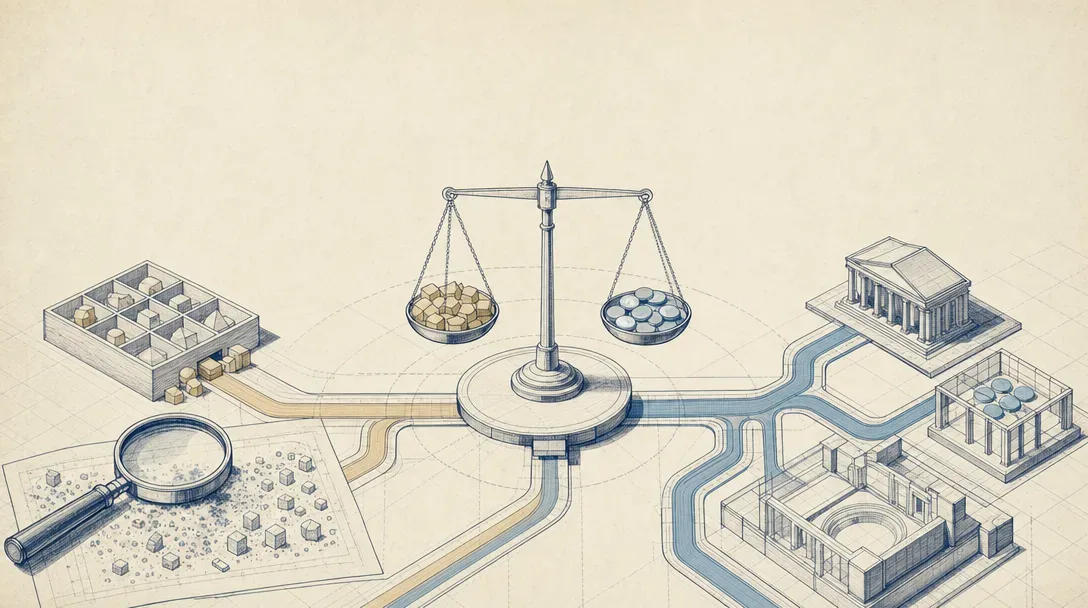
5 November 2026 is not a date for the Sde Dov Big Bloc lottery itself. It is the deadline the Herzliya Magistrates Court set for the Israel Land Authority to report on contamination testing, and only after that report can the court judge whether the lottery's valuation coefficients, the formulas the assessor used to set the relative value of each compound, still hold up.
Globes reported on 6 October 2026 that the Israel Land Authority told the court it expects laboratory results on the Big Bloc soil samples within about 30 days, and the court ordered an update on completion of testing and in any case by 5 November. No lottery date has been set, and the public record does not describe what happens procedurally once the 5 November update is filed.
The lottery actually covers three destinations, not one. Two of them, the Eshkol compound and a second compound, are zoned sub-areas (Hebrew מתחם, mitcham) inside the district's TA/4444 masterplan, and it is these two compounds the court's contamination concern is about. The third destination sits under a separate plan, TA/3700, with its own allocation of about 202 units. Ynet's report on the underlying court ruling describes all three as part of the roughly 1,700-rights-holder lottery, but the valuation dispute the Herzliya court is testing applies specifically to the two TA/4444 compounds.
Why did the court halt the Big Bloc lottery on 30 August 2026?
The Herzliya Magistrates Court halted the Big Bloc compound lottery on 30 August 2026 because Judge Yaakov Shaked found no factual basis to assume contamination affects every compound equally. Ynet reported that unequal contamination, clean-up cost or delay between compounds could change their relative value, risking an unequal division of rights worth billions of shekels.
The Big Bloc, Hebrew הגוש הגדול (HaGush HaGadol), is several hundred dunams of privately owned land inside the Sde Dov district (a dunam is about 1,000 square metres), whose rights have been managed collectively since the 1970s by five managers appointed as part of a process to dissolve shared ownership, according to Ynet.
Judge Shaked wrote that if the scope of contamination, the time needed to treat it, or the cost of cleaning it differs between the Eshkol compound and the second compound, their values could be affected differently, which could in turn require changing the coefficients the managers' assessor used to split the rights. He rejected running the lottery now and correcting the allocation later, reasoning that a late change to the coefficients could mean moving rights holders between compounds and recalculating the whole division after the fact, rather than once at the outset. Ynet reported that the judge put the value of the rights at stake in the billions of shekels, which is why he treated a premature lottery as a real risk rather than a timing inconvenience.
Separately, Globes reported that Adam Teva V'Din, an Israeli environmental advocacy group involved in the underlying case, opposed a recommendation from Israel's High Court to strike the contamination petition, keeping the legal question of responsibility for clean-up open alongside the valuation dispute the Herzliya court is weighing.
What changed on 6 October 2026: drilling, lot 2101 and the lab backlog
Drilling across the Big Bloc's private lots in plan TA/4444 is now complete except for lot 2101, which needs chisuf (early soil stripping) before a rig can reach sampling depth, the Israel Land Authority told the Herzliya Magistrates Court on 6 October 2026, according to Globes. The update describes where testing stands, not what the soil contains.
The Israel Land Authority said the Environment Ministry had approved all drilling plans, clearing the way for sampling across the remaining lots. It told the court that a backlog at the testing lab means results are expected within about 30 days, pushing the likely answer toward early November 2026. That is why the court set 5 November as the outer limit for an update rather than a fixed date for lab results themselves.
None of this tells a rights holder how much contamination the lab will find, only that the mechanical steps needed to find out are nearly finished. The 1,700-rights-holder lottery stays frozen until the numbers come back, and the court has not indicated it will schedule a draw before then.
Will the 5 November filing bring full results, partial results, or another extension?
Three outcomes are realistic for the Israel Land Authority's 5 November 2026 filing: completed lab results, partial results, or another request to extend. Each would change the lottery timeline and a rights holder's negotiating position differently, though the public record does not yet show which one is coming or what a post-5-November timetable would look like.
Public reporting does not describe what happens procedurally once results are filed: how quickly the assessor could revise coefficients, or whether the court would set a new lottery date immediately or invite further objections first. Buyers tracking which 2026 and 2027 dates actually move a transaction, as opposed to ones that only move a court docket, can check the fuller calendar of every Sde Dov date that matters for buyers.
| Filing on 5 November | What it would show | Effect on lottery timing | Effect on a rights holder's position |
|---|---|---|---|
| Completed lab results | Contamination scope across the Eshkol and second compounds | Court can assess whether coefficients need revision; a lottery date becomes possible once the assessor responds | Clearer basis to value a compound assignment before selling or buying |
| Partial lab results | Some lots tested, others, such as 2101, still pending | Court likely keeps the freeze until outstanding lots are covered | Uncertainty persists; valuation stays provisional |
| Further extension request | No usable lab data yet, citing the lab backlog | Repeats the pattern already seen in May, August and October 2026; lottery stays halted | Rights holders wait longer with no fixed date |
Is Big Bloc contamination compound-wide or lot by lot, and why does it matter for value?
Whether contamination sits evenly across each compound or concentrates in specific lots is the live dispute behind the valuation question. The Big Bloc's own managers cited compound-wide figures when they argued against a further delay in August 2026: Ynet reported that the managers put contamination potential at about 46% of rights in the Eshkol compound and about 56.8% in the second compound.
Adv. Galit Rozovsky, a Big Bloc manager, told a Globes conference in September 2026 that she still views the issue as lot-specific rather than compound-wide, and argued the polluter, not private landowners, should pay for clean-up.
The distinction matters because the court's coefficients divide rights between compounds, not between individual lots. Ynet's reporting on the underlying mapping names specific lots under suspicion: plot 102 in the Eshkol compound, and plots 2201, 2210, 2213 and 2266 in the second compound, each requiring four soil samples per dunam rather than the standard two. If contamination really is concentrated in a handful of named lots, a compound-wide coefficient could overstate the damage to a compound as a whole. If it tracks closer to the managers' 46% and 56.8% figures, the compound-level adjustment the court flagged becomes harder to avoid.
What is the difference between the September 2025 rights table and the 2026 compound lottery?
A court approved the rights table for 1,892 Big Bloc owners in September 2025. A rights table, in this context, is the court-approved list that sets how many housing units each private owner is entitled to relative to all other owners in the Big Bloc, not which compound they will receive those units in. That milestone settled the first question. It did not settle which compound, Eshkol, the second compound, or plan TA/3700, each of those roughly 1,892 owners would actually get their units from. That later step, the compound lottery for about 1,700 rights holders, is the one still frozen as of October 2026.
a Big Bloc rights-table share and an assigned compound unit are not the same asset. Ask explicitly which one is being offered before valuing any private Big Bloc deal.
The allocation covers three destinations: the Eshkol compound, about 818 housing units; a second compound, about 1,483 units; and plan TA/3700, about 202 units, according to the figures reported by Ynet. Retired Tel Aviv District Court president Eitan Ornstein chairs the lottery committee set up to run the draw, a mechanism the court established back in 2022. Advocate Doron Kochavi represents the group of rights holders who petitioned against running the compound lottery before contamination results were known, the objection that led directly to the 30 August 2026 halt.
Should a Big Bloc rights holder sell before or after the lottery?
A Big Bloc rights holder deciding whether to sell now or wait for the compound lottery, and a buyer offered private land or an option tied to it, face the same open question: nobody can yet say how contamination findings will move the compound coefficients. Four checks apply before either side signs anything while the 5 November deadline is still pending.
Confirm exactly what is being sold. A share in the 1,892-owner rights table is not the same as an assigned unit in the Eshkol compound, the second compound or plan TA/3700, because the compound lottery has not run.
Ask who bears remediation cost under the contract. Adv. Galit Rozovsky has argued the polluter should pay, but no ruling in the public record settles that question for the private lots.
Check whether the contract or option addresses a partial or delayed lab filing. The record does not show standard language for this scenario; ask a lawyer what happens if the 5 November update is incomplete.
Compare any asking price against figures from before contamination surfaced in March 2026, since the coefficients the assessor set before that date are exactly what the court is now testing.
a private Big Bloc deal struck now still rests on coefficients the court itself has called into question. Signing before 5 November does not remove that uncertainty; it only changes who is holding the exposure when results arrive.
Buyers weighing a private-land purchase rather than a tendered apartment should work through the fuller checklist in buying Sde Dov land from a private owner, and foreign buyers timing a signature against the tax schedule should read how signing before or after February 2027 interacts with a delayed closing.
Frequently asked questions
What is the Sde Dov Big Bloc?
The Big Bloc (Hebrew הגוש הגדול, HaGush HaGadol) is several hundred dunams of privately owned land inside the Sde Dov district, with rights managed collectively since the 1970s by five managers appointed to dissolve shared ownership, according to Ynet. A dunam is about 1,000 square metres. The land sits within plan TA/4444 and plan TA/3700, and its private owners are distinct from land the Israel Land Authority sells to developers by tender.
How many owners actually hold rights in the Big Bloc?
A Herzliya court approved a rights table for 1,892 private owners in September 2025, setting each owner's share of units relative to the rest. The compound lottery that is now frozen covers a narrower group, about 1,700 rights holders, because it allocates which compound each owner's units will come from rather than how many units they hold. Ynet reported both figures in its coverage of the underlying ruling.
Who is responsible for paying to clean up the PFAS contamination at Sde Dov?
No ruling in the public record settles who pays for the clean-up. Adv. Galit Rozovsky, a Big Bloc manager, told a Globes conference in September 2026 that she views the contamination as lot-specific and argued the polluter, not private landowners, should bear the cost. Separately, Adam Teva V'Din, an environmental group, opposed a High Court recommendation to strike the related contamination petition, keeping the responsibility question open alongside the valuation dispute.
How many times has the Big Bloc lottery date been pushed back?
The compound lottery has been delayed at least three times since mid-2026. It was originally set for late June 2026, postponed to 11 August after landowners asked for more time, then halted entirely by the Herzliya Magistrates Court on 30 August 2026 over contamination concerns. An Israel Land Authority update on 6 October 2026 pushed the next checkpoint to 5 November 2026, with no new lottery date yet set.
Who chairs the Big Bloc lottery committee, and when was it created?
Retired Tel Aviv District Court president Eitan Ornstein chairs the committee responsible for running the Big Bloc compound lottery, a mechanism the court established in 2022. Advocate Doron Kochavi represents the group of rights holders whose objection to running the lottery before contamination results were known led directly to the court's 30 August 2026 halt. Neither figure has publicly stated when a new lottery date might be set.
Is private Big Bloc land the same as land sold by the Israel Land Authority via tender?
No. The Big Bloc is privately owned land whose rights have been held collectively by about 1,892 owners since the 1970s, while most Sde Dov apartments are built on land the Israel Land Authority sells to developers through public tenders. Big Bloc owners receive housing rights through the compound lottery, not through a tender purchase, so valuing a stake in it means checking which rights table and compound apply rather than comparing it to a tendered project's asking price.
Sources
Questions About Buying Here?
We are an independent guide. Tell us what you are looking at and we will answer with sources.