
When the Temporary Limits on 20/80 and Developer-Funded Deals End: What 2027 Could Change
The Bank of Israel's temporary limit on developer-funded payment plans runs only to 31 December 2026, and no 2027 extension or replacement has been published. Here is what the 20/80 structure is, why it was capped and what it does not change.
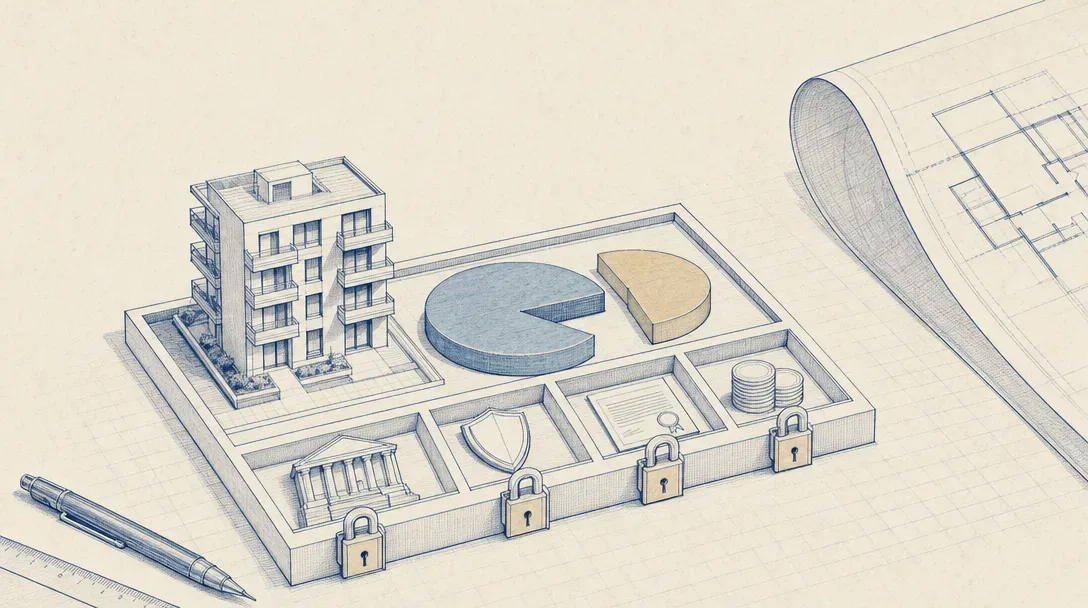
What is a 20/80 deal, and what did the Bank of Israel limit in 2025?
A 20/80 deal lets a buyer pay about a fifth of the price at signing and defer the remaining 80 percent to delivery, often with the developer covering the interest. As of October 2026, the Bank of Israel's temporary limit on these developer-funded structures runs only through 31 December 2026, with no 2027 extension or replacement yet published.
Circular 2816, issued by the Bank of Israel's Banking Supervision Department on 6 April 2025, is the instruction behind that deadline. It restricts bullet and balloon loans on which a developer pays the interest, the financing structure that lets a deferred-payment plan look costless to the buyer at signing. In Israeli property marketing, the two numbers in a plan name describe the split between the share paid during construction and the share due near delivery: a 10/90 deal defers even more of the price, a 40/60 deal less.
According to the Bank of Israel's 2024 banking system annual survey, published in May 2025, and the brief underlying this article, circular 2816 is a temporary order running through 31 December 2026, not a permanent change to Israeli lending rules. Nothing in the supplied record says what, if anything, replaces it afterwards.
Why did the Bank of Israel restrict developer-funded payment plans?
The Bank of Israel restricted developer-funded payment plans because it saw financing risk building outside the banking system it actually supervises. In its 2024 annual survey of Israel's banking system, the Banking Supervision Department says it used regulatory tools "to limit emerging risks, including by means of regulatory tools (for example, hedging the emerging risk from the financing offered to buyers by contractors)."
Circular 2816 turned that concern into a numeric cap. Developer-paid-interest bullet and balloon loans are now limited to 10 percent of each bank's quarterly mortgage lending, under the temporary order in force since 6 April 2025 and running through 31 December 2026. The cap targets the lending channel, not the sale contract itself. A developer can still offer a deferred schedule, but the bank behind it has less room to subsidise the interest on it than it did before April 2025.
Does deferring 80% of the price lower your total cost, or only the timing?
Deferring most of the price to delivery shifts when the money leaves your account. It does not shrink what the contract can eventually cost, once index linkage and the developer's own financing are counted. For contracts signed from 7 July 2022, no more than 40 percent of the apartment price can be linked to the construction inputs index published by Israel's Central Bureau of Statistics, under the Sale (Apartments) Law 1973 as amended.
Shavnu's off-plan protection guide works through the arithmetic on a ₪6.8M contract, comparing the rule now in force with the practice it replaced:
Purchase tax is still calculated on the full contract price, whichever payment track a buyer picks; deferring 80 percent of the price to delivery does not defer that tax calculation. Calcalist reported in December 2025 that FIRST, a developer marketing a project in Sde Dov, offered two tracks on one contract: the full list price on easier terms, or a lower price tied to a faster schedule of ₪50,000 at the purchase request, 7 percent at contract, a top-up to 35 percent when the building permit is issued, 12.5 percent two years later, a further 12.5 percent two years after that, and the balance six months before Tofes 4, the occupancy approval.
Bizportal reported in June 2026 that developers' financing offers across the district carry a hidden cost of 6 to 8 percent against the listed price, a gap that rarely shows up in the headline payment schedule.
| Before 7 July 2022 | From 7 July 2022 | |
|---|---|---|
| Share of price that can be index-linked | Up to the full unpaid balance | Up to 40 percent of price |
| Linkable amount on a ₪6.8M contract | Up to ₪5.44M of the balance after a 20 percent down payment | Up to ₪2.72M |
| Cost of a 1 percent index rise | Scales with the full linked balance | Capped at ₪27,200 |
| Index used | Construction inputs index (CBS) | Construction inputs index (CBS) |
Can you actually get a mortgage for the final 80% when the time comes?
Signing a contract that defers 80 percent of the price does not change how much a bank will actually lend when that balance comes due. Bank of Israel Directive 329 caps a foreign resident at 50 percent of the lower of the contract price and the bank's own appraisal, a qualifying sole-home buyer at 75 percent, and a replacement-home buyer at 70 percent. Those ceilings were last reconfirmed on 30 June 2026 under circular 2852 and have not moved.
Two further changes narrow the room to manoeuvre. From 1 October 2026, under circular 2840 (its start pushed back from 1 July 2026 by circular 2852), repayments on every loan already secured on the property count toward the 50 percent repayment-to-income limit. At the same bank, the two-thirds cap on variable-rate borrowing is now measured across all credit secured on that same property, rather than loan by loan. On the process side, Bank of Israel Directive 451 requires a bank to answer a mortgage request within 5 business days, or 7 in defined exceptional cases, and to hold the quoted rate for at least 24 days from the approval in principle, a window that matters little when the final instalment is still years away.
A 20/80 structure changes when the price is paid. It does not change how the bank underwrites the loan at the end of that schedule.
What if the delivery-day appraisal comes in below your contract price?
A bank lends against whichever figure is lower, the contract price or its own appraisal, and that rule does not relax because 80 percent of the price was deferred. If the delivery-day appraisal lands below the price a buyer agreed years earlier, the 50, 70 or 75 percent Directive 329 ceiling applies to the lower appraisal figure. That shrinks the loan and widens the cash gap the buyer has to close out of pocket, right at the point the deferred balance falls due.
the supplied record does not contain an appraisal-gap figure specific to a 20/80 contract in Sde Dov. Treat any claim about how large that gap could be as unconfirmed until a buyer's own bank appraiser puts a number on it.
Is a 20/80 extension or replacement confirmed for 2027?
No extension or replacement of the Bank of Israel's temporary limits has been published in the record supplied for this article, as of October 2026. What is confirmed is narrower: the restriction on developer-funded bullet and balloon structures, set by circular 2816 of 6 April 2025, runs through 31 December 2026, according to the Bank of Israel's 2024 banking system annual survey and the brief this article draws on.
Nothing in that record states that the order will be extended past that date, replaced with a different cap, or simply allowed to lapse. A sales office promising that 20/80-style terms will "come back" or "stay gone" after 1 January 2027 is making a claim this record does not support either way. A buyer weighing a contract that straddles that date should ask the sales office, in writing, what happens to the financing terms if the current order expires without a published successor, and should check the Bank of Israel's own publications again closer to signing rather than relying on a marketing pitch.
What to ask the sales office and your lawyer before signing a deferred-payment contract
The five statutory protections under the Sale (Apartments) (Assurance of Investments of Purchasers of Apartments) Law 1974 work only if they are written into the contract itself, not left to a brochure. Confirm each of the following before signing, in the contract text, not in a sales presentation.
Index linkage terms. Confirm the cap is 40 percent of the price, consistent with contracts signed from 7 July 2022, and ask the sales office to model what a 1 percent rise in the construction inputs index would add in shekels on your specific contract.
The 7 percent rule and the five securities. A developer cannot hold more than 7 percent of the price unsecured; ask which of the five statutory securities under section 2 of the 1974 law covers every payment above that, and get the name of the bank or insurer on paper.
The voucher book and the 14-day window. Confirm the accompanying bank is already issuing a voucher book under section 3B, and that each voucher payment triggers a guarantee or policy within 14 business days.
Your own lender's section 3C check. If you are financing part of the price, ask your bank to confirm in writing that it has reviewed the Sales Law security, or the seller's written undertaking to provide it, before releasing each draw.
The accompanying bank's track record. Ask which bank is financing the project and on what scale. Shavnu's off-plan protection guide records that Discount and Hapoalim financed Luzon Ronson's lot 2227, a single plot within the district used here only as an example of financing scale rather than a project under review, for roughly ₪700M in June 2025.
ask for the payment schedule, the index-linkage clause and the security confirmation as three separate line items, not a single paragraph. Each one is governed by a different rule, and a contract that blends them makes it harder to check any of the three.
This is general information, not legal, tax or financial advice; your own lawyer should confirm how these clauses read in the contract you are actually offered. Shavnu publishes the published price lists, tender results and recorded deals across Sde Dov's projects, which is one way to check a sales office's payment-plan pitch against what has actually closed elsewhere in the district. The separate purchase tax deadline for foreign residents follows its own calendar, covered in the foreign-buyer tax rate explainer for signing before or after February 2027.
Frequently asked questions
How is a 20/80 deal different from a 10/90 or 40/60 deal in Israel?
The two numbers describe how a developer splits the purchase price between construction and delivery: a 20/80 deal has the buyer pay 20 percent during construction and 80 percent near delivery, while a 10/90 deal defers even more of the price and a 40/60 deal defers less. All three structures can carry developer-subsidised interest, the financing channel Bank of Israel circular 2816 now caps at 10 percent of each bank's quarterly mortgage lending. The split itself is a contract term, not a regulated product.
Are 20/80 payment plans currently illegal in Israel?
No, the deal structure itself is not banned. Circular 2816, issued by the Bank of Israel's Banking Supervision Department on 6 April 2025, limits only the bank financing behind it, capping developer-paid-interest bullet and balloon loans at 10 percent of each bank's quarterly mortgage lending through 31 December 2026. A developer can still offer a 20/80 schedule; the bank behind it simply has less room to subsidise the interest than it did before April 2025.
What is Tofes 4 and why does it appear in developer payment schedules?
Tofes 4 is the occupancy approval Israeli authorities issue once a building passes final inspection, marking the point at which a buyer can legally move in. Calcalist reported in December 2025 that a Sde Dov developer, FIRST, scheduled the final instalment of its accelerated payment track for six months before Tofes 4 is issued, tying the last large payment to a regulatory milestone rather than a fixed calendar date.
Does choosing a 20/80 payment plan reduce the purchase tax you owe?
No, purchase tax is calculated on the full contract price regardless of which payment track a buyer signs. Deferring 80 percent of the price to delivery changes when the money is paid, not the base used to calculate mas rechisha. A buyer comparing a full-price, easier-terms track against a discounted, accelerated-schedule track from the same developer should model tax on each contract price separately, since the two tracks can carry different contract prices and therefore different tax bills.
How much money can a developer legally take from a buyer before securing it?
A developer cannot hold more than 7 percent of the apartment price unsecured, under section 2 of the Sale (Apartments) (Assurance of Investments of Purchasers of Apartments) Law 1974. Every payment above that threshold must be covered by one of five statutory securities, most commonly a bank guarantee issued through a voucher book within 14 business days of payment. This rule applies whether the contract uses a 20/80 schedule, a 10/90 schedule, or a conventional staged payment plan.
Why do some Sde Dov developers offer two different prices for the same apartment?
Developers sometimes price the same unit on two tracks because the payment schedule changes the cost of financing the sale. Calcalist reported in December 2025 that FIRST offered a full list price with easier payment terms alongside a lower price tied to a faster schedule, starting at 7 percent at signing and rising to 35 percent on building-permit issuance. Bizportal reported in June 2026 that developer financing offers across the district carry a hidden cost of 6 to 8 percent against the listed price.
Sources
- Israel Tax Authority, Execution Instruction 1/2026 (purchase tax brackets)
- Bank of Israel, Directive 329 on mortgage limits, version 13 (circular 2852)
- Bank of Israel: policy rate and decision calendar
- Bank of Israel, circular 2816: limits on developer-funded purchase terms
- Sale (Apartments) (Assurance of Investments) Law, 1974, on Nevo
Questions About Buying Here?
We are an independent guide. Tell us what you are looking at and we will answer with sources.