
Eighty-One Years on the Sand: The Complete History of Sde Dov Airport
From a 1938 strip opened during the Arab Revolt to the last departure on 30 June 2019: how Tel Aviv’s city airport was built, named, fought over, and taken apart, and what Runway Park still keeps.
Built Because the Road to Lydda Was Unsafe
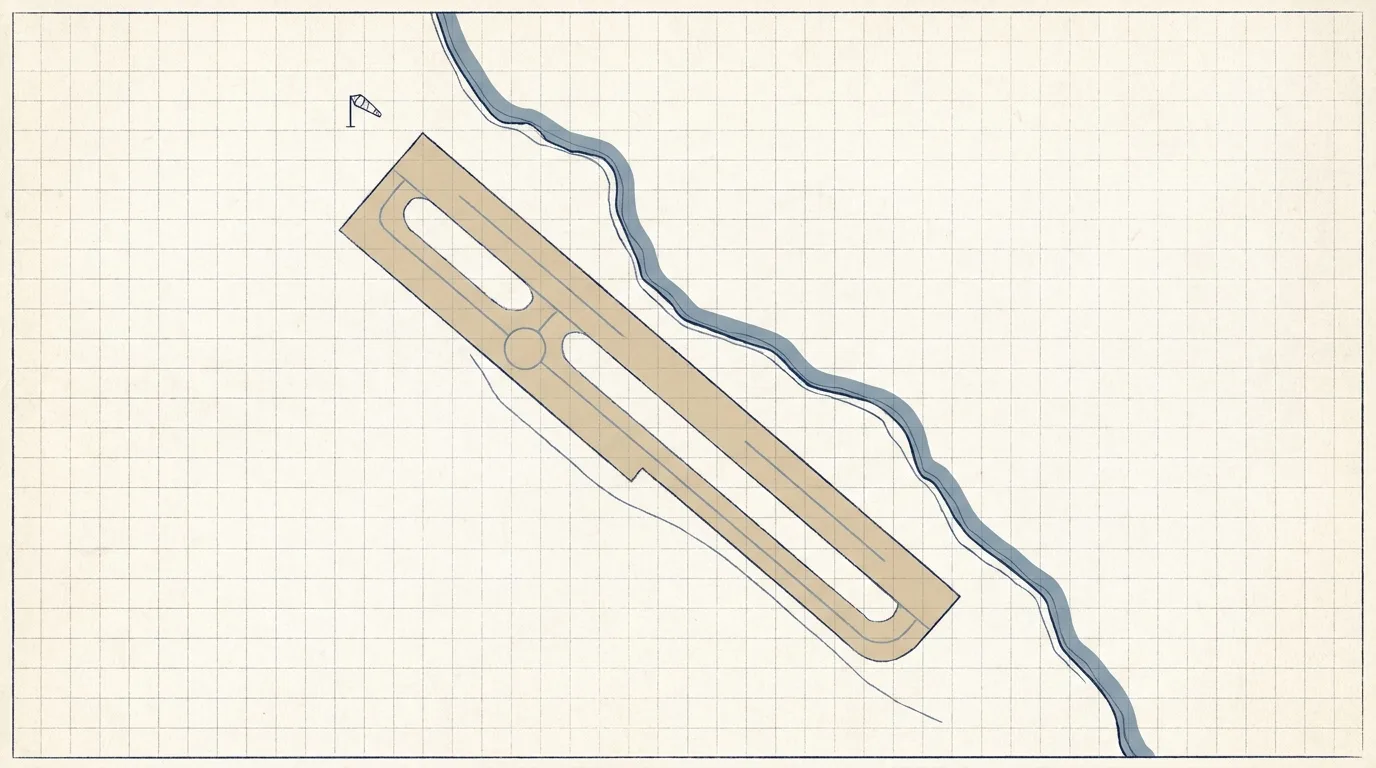
Sde Dov opened on 3 September 1938, during the Arab Revolt, as Tel Aviv’s alternative to Lydda. When the roads to that inland field were unsafe, an airfield was carved out of the dunes north of the Yarkon, on the coast that is now about 1,300 dunams (1,000 square metres each) of northwest Tel Aviv.
Palestine Airways flew from here in those first years. Zoltan Kluger’s Government Press Office photograph of the main hangar, taken the year the field opened, shows light aircraft on bare sand, registrations VQ-PAA and VQ-PAB still readable, one fuselage already inside the shed. There is no paved apron in the frame. The airport began as a hangar and tyre tracks on the sand.
The same year, Pinchas Rotenberg’s Reading Power Station (רדינג) opened on the southern edge of the same strip. district records later recorded that the station was also a secret Haganah (הגנה, the pre-state Jewish defence organisation) weapons factory. Airfield and power plant, civil and clandestine, sat on one piece of coast from the start.
Opening date and Palestine Airways: Wikipedia / research timeline. Hangar photograph: GPO, Zoltan Kluger, 1938. Reading and Haganah factory: district records, 17 Aug 2026.
Named for Dov Hoz
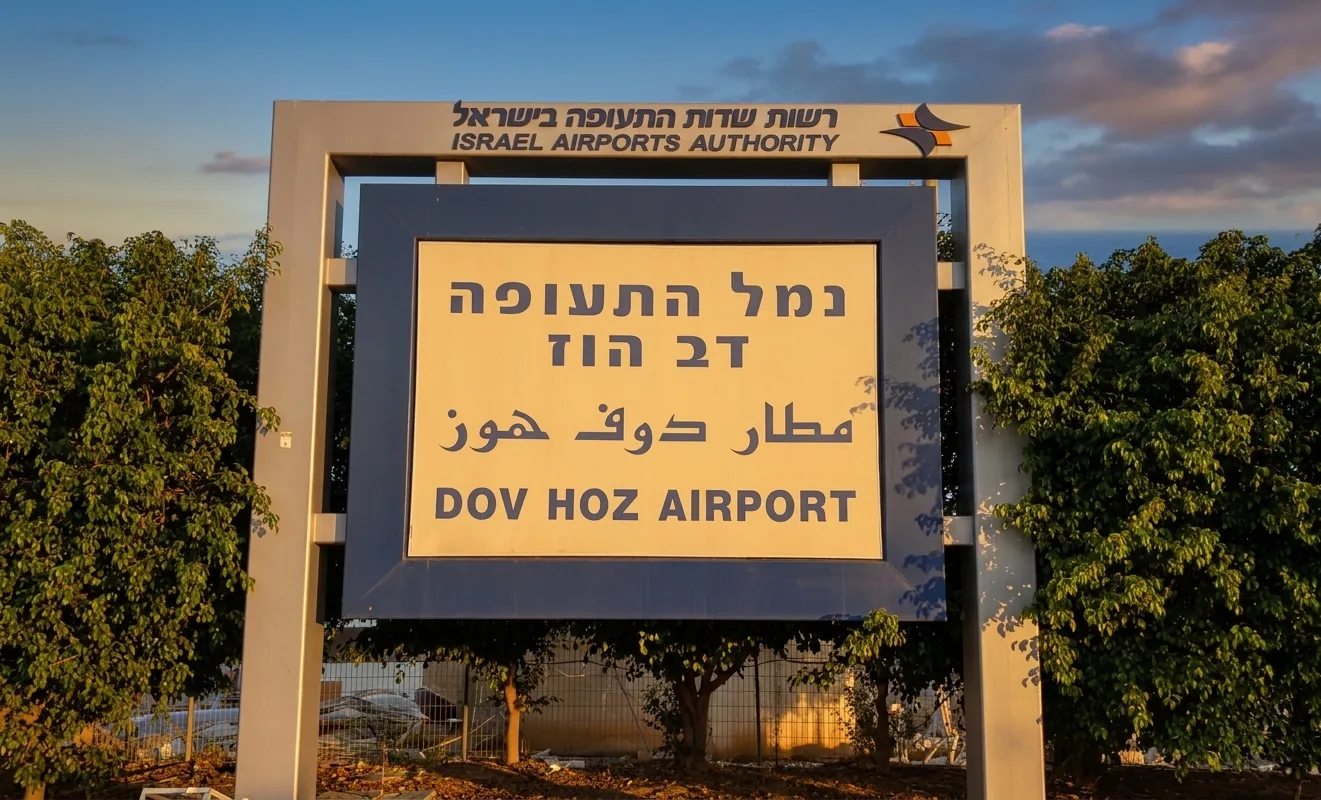
The field was renamed in 1940 for Dov Hoz (דב הוז), the Hebrew aviation pioneer whose name the district still carries. district records published his biography in August 2025. The English form Sde Dov sits beside the Hebrew Nemal HaTe’ufa Dov Hoz (נמל התעופה דב הוז, Dov Hoz Airport). The later rova (רובע, district) inherited the same name.
The Israel Airports Authority sign at the gate, photographed before closure, still carried the name in Hebrew, Arabic, and English. Behind the fence in that picture, a light aircraft sits on the ground. From 1940 until the last summer, the official name on the post was a person, not a neighbourhood.
Rename in 1940: GPO historic records. Biography: district records, 6 Aug 2025.
RAF, Then the first Squadron
During the Second World War the strip served as an RAF base. In December 1947 it became home to the first Haganah / Israel Air Force squadron, months before independence. A field built as a workaround had become the pad from which a state that did not yet exist flew its first organised air unit.
Civil and military use never fully separated. For decades the air force kept a presence on the field even as scheduled domestic flights used the same runway. When the airport finally closed, the last IAF sortie went to Hatzor. That dual life is why closing Sde Dov was never only a planning file. The Defense Ministry had to be paid to leave early, the Supreme Court had to set a date, and Eilat had to be compensated for losing the hop.
RAF and December 1947 squadron: Wikipedia. Final IAF sortie to Hatzor: ITN, 2019, and the typed timeline.
The Eilat Shuttle
Tel Aviv grew around the fence. By the late decades the little airport’s main civil job was the hop to Eilat. In its final full year of operations the field moved 703,649 passengers, most of them on that southern shuttle.
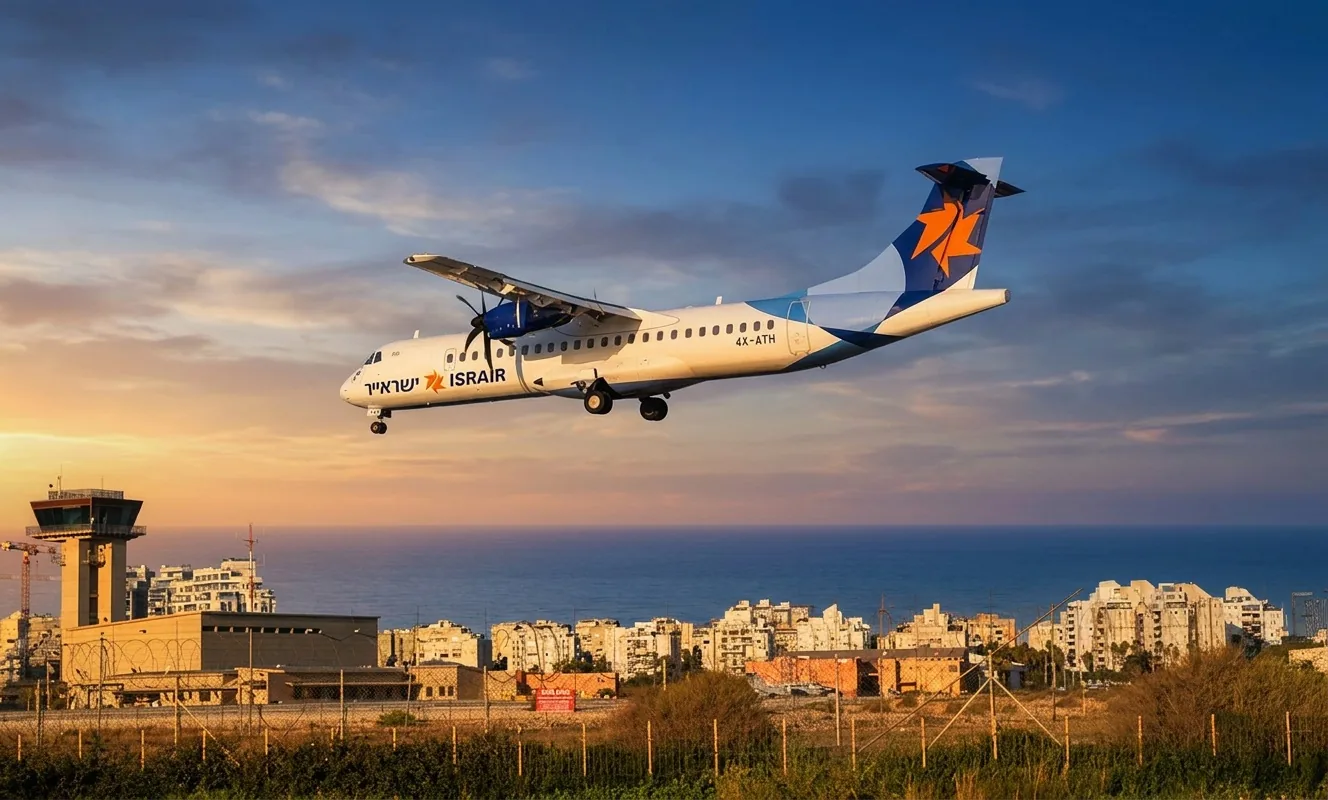
Photographs from those years fix the geometry. An Israir turboprop on short final, the control tower in the same frame, apartment blocks already hard against the boundary. The city had closed in. There was no spare sand left for a longer runway.
Aviation listings recorded the field as Tel Aviv Sde Dov, identifier SDV. That code is now a historical label. The people inside that last-year total were not on long-haul routes. They were on the Eilat shuttle.
703,649 passengers in the final full year: Wikipedia. SDV code: CAPA airport profile. Eilat shuttle: compiled press coverage.
Fifty Years Over the Same Sand
The land under the runway was never a blank state parcel. Inside the fence sat HaGush HaGadol (הגוש הגדול, the Big Bloc): private parcels bought by families generations earlier. A court finished the rights table for 1,892 owners only in September 2025. Around those parcels, the state, the city, and the army argued for half a century about whether aircraft or housing should occupy this coast. district records later framed that argument as “half a century of struggle” behind the nickname “Tel Aviv’s Diamond.”
A government decision in 2010 and 2012 traded the airfield for housing. Outline plan TA/3700, a separate plan covering about 1,900 dunams of Tel Aviv coast north of the airfield, was approved on 3 July 2012. The Hebrew headline on that coverage still said 12,000 housing units, TA/3700's own program for its own area. Two years later Sde Dov's separate program would be set larger, at 16,000 units. The airport was still open while that neighbouring coast was being planned for housing.
On 28 October 2012 the government approved a Dov Hoz evacuation plan aimed at 2018, under the headline “apartments instead of planes.” On 5 December 2012 it formally backed the airport’s evacuation. The close-down had a cabinet paper. It did not yet have a last departure.
Big Bloc: district records, 18 Dec 2025 and 17 Sep 2025. TA/3700 and 2012 decisions: the district news archive, 3 Jul, 28 Oct, and 5 Dec 2012. TA/3700 as a separate, neighbouring plan: Globes, Aug 2024; Shoob & Co. planning-law note.
How a Working Airport Was Dated Out of Existence
On 3 September 2014, seventy-six years to the day after the field opened, the steering committee, with city engineer Oded Gvuli, updated the housing program to 16,000 units. That is still the figure on plan TA/4444. On 6 June 2015 the state paid the Defense Ministry about ₪1B so the army would leave before the original timetable. Early evacuation had a price. The soldiers’ clock and the planners’ clock were now on the same invoice.
The Supreme Court, on 26 February 2016, postponed the final evacuation to January 2019 and in doing so locked the close of the 81-year field. That June, Mayor Ron Huldai promoted an alternative that would have kept the civil airport running. Coverage on district records records the proposal. It did not become the outcome. Aircraft kept using the runway while the housing mix was argued in public: in March 2017 Deputy Mayor Meital Lehavi described a program with 2,100 affordable units and 50 percent small apartments.
In February 2019, with closure months away, the coastal committee approved masterplan elements that included two parks to connect future residents to the beach. The field was still an airport. The maps were already a neighbourhood.
| Date | What the record says |
|---|---|
| 3 Sep 1938 | Airfield opens during the Arab Revolt, Tel Aviv’s alternative to Lydda |
| 1940 | Renamed for aviation pioneer Dov Hoz |
| WWII | RAF base |
| Dec 1947 | First Haganah / IAF squadron based here |
| 3 Jul 2012 | Outline plan TA/3700 approved (~1,900 dunams of coast north of the airfield) |
| 28 Oct / 5 Dec 2012 | Government approves evacuation (2018 target, then formal decision) |
| 3 Sep 2014 | Program set at 16,000 housing units |
| 6 Jun 2015 | Defense Ministry takes ~₪1B for early evacuation |
| 26 Feb 2016 | Supreme Court sets evacuation for January 2019 |
| 14 Jun 2016 | Mayor Huldai promotes keeping the civil airport |
| 30 Jun 2019 | Last flight; final IAF sortie to Hatzor; Eilat receives ₪400M |
| 31 Jul 2019 | Runway demolition begins; only the control tower is kept |
| 10 Feb 2020 | IDF and civil evacuation reported complete after 81 years |
Last Flight, Then the Runway Comes Up
On 30 June 2019 the last flight left. The final IAF sortie went to Hatzor. Eilat received ₪400M in compensation for losing the Tel Aviv hop. ITN recorded the official close. The court had named January 2019. Operations reached the end of June. Demolition did not wait long after that.
Work on taking up the runway began on 31 July 2019. The site was fully vacated by early 2020. On 10 February 2020, district records show that after 81 years the IDF and civil evacuation of the airfield was finished. One structure was kept as a historic building: the control tower. Wikimedia’s “Airport tower of Sde Dov Airport” subcategory holds 43 files of that building. It is the only structure the demolition left standing.
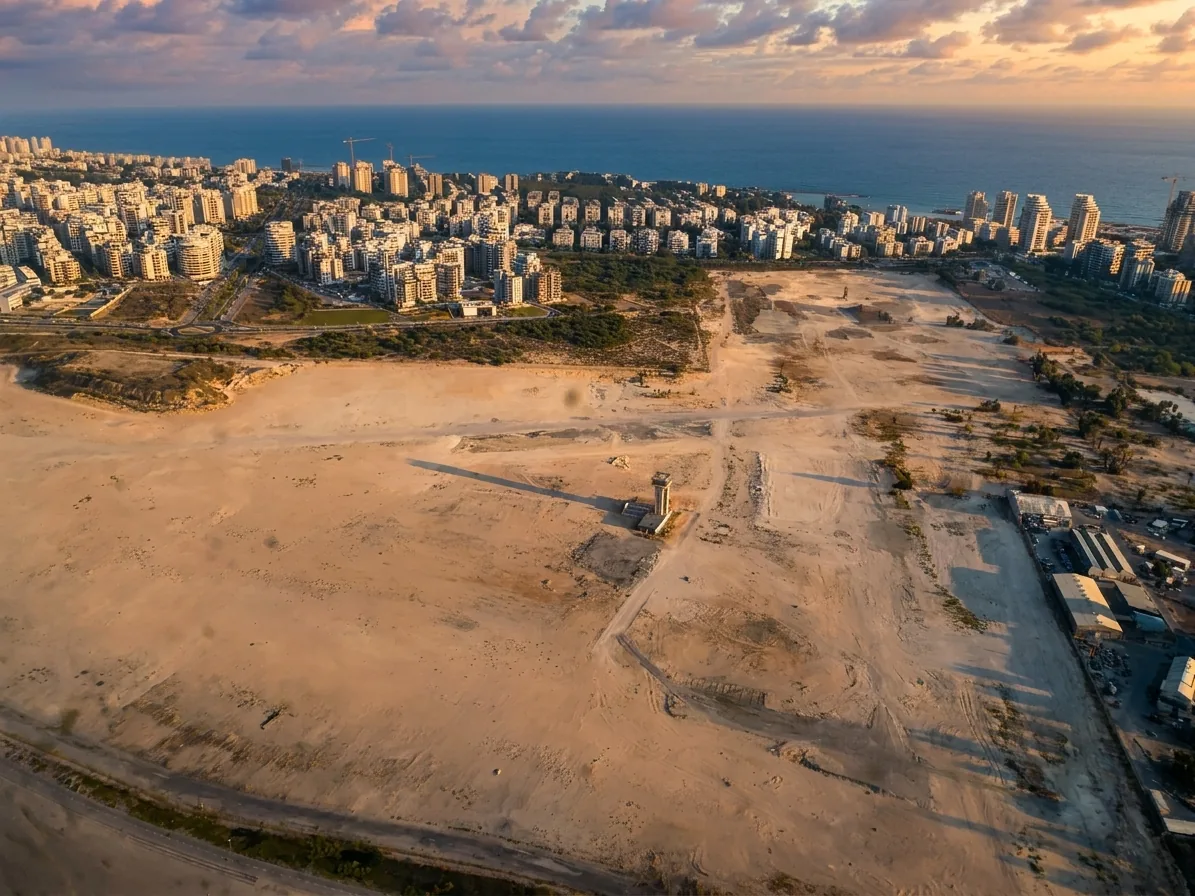
Stas Umansky’s aerial from October 2020 shows what “vacated” looked like from the air. A sand rectangle the size of a city district. The tower standing by itself near the shore. Housing packed against every inland edge. The 81-year airfield had become a blank, except for that one concrete stalk.
Only the control tower is kept as a historic building.
Last flight and Eilat compensation: ITN and the typed timeline, 30 Jun 2019. Demolition: Wikipedia / timeline, 31 Jul 2019. Evacuation complete: district records, 10 Feb 2020.
What Runway Park Keeps
Plan TA/4444, the Sde Dov district plan, came into force in August 2020: about 16,000 homes on those 1,300 dunams, three complexes, parks, hotels, and two kilometres of public beach. The old runway alignment becomes Park HaMaslul (פארק המסלול, Runway Park). The park keeps the line of the strip and the preserved tower at the centre of the new neighbourhood. district records’s January 2024 feature put both objects, park and tower, in the headline: past and future on the same axis.
Around them the plan draws Park HaChof (פארק החוף, Coastal Park), about 240 to 265 dunams along two kilometres of shore, with a promenade that opened in September 2023; a Linear Park tying the complexes together; and four Green Line light-rail stations. One station is named Zahara Levitov (זהרה לביטוב) for the pioneering woman pilot. Aviation is not wiped off the maps. It is written into a park alignment, a tower, and a station name.
The airport also left a residue that is not commemorative. PFAS compounds from decades of firefighting foam were found in soil and groundwater in February 2026. That chemistry is as much a part of the airfield’s history as the 1938 hangar photograph. A working airport used foam. The neighbourhood now inherits the cleanup.
a January 2022 retrospective called the story “81 years of history.” The years run from 3 September 1938 to 30 June 2019. First occupancy on the field is targeted around 2029. The tower will still be there when the first keys turn. It is the one building that has already outlasted the airport.
Runway Park and tower: district records, 30 Jan 2024, and glossary. TA/4444: in force from August 2020. PFAS: Nadlan Center / Globes, Feb 2026. Zahara Levitov: district records, 25 Feb 2026.
Questions about buying here?
We are an independent guide. Tell us what you are looking at and we will answer with sources.